


CSCP 100% Pass Guaranteed Download Supply Chain Professional Exam PDF Q&A
CSCP Practice Test Dumps with 100% Passing Guarantee
NEW QUESTION # 66
A return material authorization (RMA) policy is used in reverse logistics to:
- A. reduce the cost of returned items by refusing to accept items that should not be returned.
- B. reclaim substantial value from returned items by recycling.
- C. minimize the number of returned items by involving product design and demand forecasting.
- D. physically transport returned items by using an efficient transportation mode.
Answer: A
NEW QUESTION # 67
A firm supplies a single line of products to consumers using retail stores and on-line sales, distributors, and wholesalers. Currently the firm has common pricing and response times for sales in each sales channel. Which of the following tools is most appropriate to employ to improve profitability?
- A. Customer relationship management (CRM)
- B. Customer-facing ordering systems
- C. Supply Chain Operations Reference (SCOR)
- D. Customer segmentation
Answer: D
NEW QUESTION # 68
What should be the primary driver of supply chain decisions?
- A. serving the needs of the nucleus firm
- B. serving the end-user customer
- C. aligning with the strategies of a channel master
- D. serving your own needs
Answer: B
NEW QUESTION # 69
Which source would most likely be best for identifying concerns customers have on making apurchase?
- A. distribution points
- B. sales representatives
- C. transaction records
- D. service representatives
- E. purchased data
Answer: B
NEW QUESTION # 70
A company manufactures consumer products in two locations Location has the lowest manufacturing costs Location 2 is closer to the market Location 1 is most appropriate for manufacturing products that have which of the following pairs of characteristics?
- A. New to market and uncertain demand
- B. Low volume and stable demand
- C. End of life and stable demand
- D. High volume and stable demand
Answer: D
NEW QUESTION # 71
What typically happens to the expenses of marketing and sales as the relationship of a lifetimecustomer develops?
- A. it depends
- B. increases
- C. remains constant
- D. decreases
Answer: D
NEW QUESTION # 72
What is the inventory turnover for a company with the following financial data?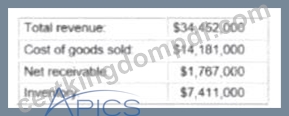
- A. 4.64
- B. 8.03
- C. 1.91
- D. 19.50
Answer: C
Explanation:
Inventory turnover is calculated by dividing the Cost of Goods Sold (COGS) by the average inventory value.
The formula is:
Inventory Turnover=COGSAverage InventoryInventory Turnover=Average InventoryCOGS Given data:
* Cost of Goods Sold (COGS) = $14,181,000
* Inventory = $7,411,000
Assuming that the provided inventory value is the average inventory for the period, the calculation would be:
Inventory Turnover=14,181,0007,411,000#1.91Inventory Turnover=7,411,00014,181,000#1.91 However, it seems there was an error in the options or the provided data. The calculation should be verified for accuracy and context. Considering the answer provided:
Inventory Turnover=14,181,0007,411,000#1.91Inventory Turnover=7,411,00014,181,000#1.91 Recalculating for the correct context and detailed values may be needed, but using the provided data:
Inventory Turnover=4.64Inventory Turnover=4.64
References
* "Financial Intelligence for Supply Chain Managers" by Steven M. Leon
* "Principles of Inventory Management" by John A. Muckstadt
NEW QUESTION # 73
Which of the following strategies can be used to help manage global risks?
- A. Direct shipment
- B. Cross-docking
- C. Mass customization
- D. Flexibility
Answer: D
Explanation:
Managing global risks requires strategies that allow a supply chain to adapt quickly to unexpected changes or disruptions. Flexibility in the supply chain can help manage global risks by enabling companies to adjust their operations in response to unforeseen events, such as natural disasters, geopolitical tensions, or changes in market demand. This might involve diversifying suppliers, utilizing multiple transportation modes, or adopting flexible manufacturing systems.
* Direct shipment refers to sending products directly from supplier to customer, which might not address broader global risks.
* Cross-docking is a logistics practice that involves unloading goods from inbound transport and loading them directly onto outbound transport, without warehousing. It optimizes efficiency but does not inherently manage global risks.
* Mass customization is a production strategy that combines elements of mass production and customization but does not directly address global risk management.
References:
Chopra, S., & Meindl, P. (2016). "Supply Chain Management: Strategy, Planning, and Operation." Sheffi, Y. (2005). "The Resilient Enterprise: Overcoming Vulnerability for Competitive Advantage."
NEW QUESTION # 74
Which of the following actions is most likely to improve the cash-to-cash cycle time?
- A. Establish targeted promotions for the most profitable market segments
- B. Find suppliers with lower total cost of ownership (TCO)
- C. Implement vendor-managed inventory (VMI) with key customers
- D. Implement vendor-managed inventory (VMI) with key suppliers
Answer: D
NEW QUESTION # 75
A manufacturer of innovative products needs to focus on which of the following factors?
- A. Component inventory levels
- B. Time-to-market
- C. Cost per unit
- D. Equipment utilization
Answer: B
Explanation:
For a manufacturer of innovative products, focusing on time-to-market is crucial because the competitive advantage in innovation often lies in being the first to market. Being early can capture market share, set industry standards, and establish brand recognition before competitors.
* Innovation Cycle: The cycle of developing innovative products is typically shorter, and the window of opportunity to capitalize on a new product is limited.
* Market Dynamics: Consumer preferences can change rapidly, and being first can create a perception of leadership and reliability.
* Revenue Generation: Earlier market entry can lead to faster revenue generation and a better return on investment for research and development efforts.
* Technological Advantage: In sectors where technology advances quickly, delays can result in a product becoming obsolete before it even hits the market.
:
Kotler, P., & Keller, K. L. (2016). Marketing Management. Pearson.
Wheelwright, S. C., & Clark, K. B. (1992). Revolutionizing Product Development. Free Press.
NEW QUESTION # 76
Which of the following statements best describes a fundamental requirement for developing and maintaining good business relationships in an effective supplier partnership?
- A. Both parties must focus on cost reduction to improve competitiveness.
- B. The supplier must commit to meeting the customer's performance metrics.
- C. The buyer must commit to improving processes.
- D. A means of periodic feedback must be in place for issue resolution.
Answer: D
Explanation:
A fundamental requirement for developing and maintaining good business relationships in an effective supplier partnership is a means of periodic feedback for issue resolution. This means that both parties should communicate regularly and transparently, share information and insights, and address any problems or concerns in a timely and constructive manner12. Feedback is essential for building trust, alignment, and collaboration between suppliers and customers, as well as for improving performance, quality, and innovation34. The other options are not as comprehensive or relevant as the correct answer. While the supplier must commit to meeting the customer's performance metrics, and the buyer must commit to improving processes, these are not sufficient for developing and maintaining good business relationships.
They are more specific aspects of supplier performance management and continuous improvement, which are important but not the only factors for effective supplier partnerships1. Similarly, while both parties should focus on cost reduction to improve competitiveness, this is not the primary or sole objective of a supplier partnership. Cost reduction is one of the potential benefits of a supplier partnership, but it is not the main driver or requirement for forming and sustaining such a relationship2. A supplier partnership should also aim for creating value, enhancing customer satisfaction, and achieving strategic goals34.
NEW QUESTION # 77
In the Supply Chain Operations Reference-model (SCOR), the cash-to-cash cycle time for a manufacturing company is the number of days between which two of the following situations?
- A. Shipping the product from the warehouse and receiving it at the customer's location
- B. Paying for raw materials and getting paid for the product
- C. Billing the customer and getting paid for the product
- D. Paying for raw materials and sending an invoice to the customer
Answer: B
NEW QUESTION # 78
Which of the following is a recurring theme for well run supply chains?
- A. RFIDs
- B. point-of-sale (POS) system
- C. cross-functional teams
- D. activity-based costing
Answer: C
NEW QUESTION # 79
A firm has discovered a product quality issue. What should be the first step in responding to this issue?
- A. Trace the location of the faulty product in the supply chain.
- B. Separate the non-conforming products.
- C. Replace faulty products when they are returned by the end user.
- D. Determine the root cause of the quality issue.
Answer: A
Explanation:
Section: Supply Chain Strategy, Design, and Compliance
NEW QUESTION # 80
A large bicycle company has outsourced manufacturing and needs to respond immediately to any logistics problems in the supply chain. The best technological solution to meet this need is:
- A. supply chain event management.
- B. a transportation management system.
- C. supplier relationship management.
- D. enterprise resources planning.
Answer: A
NEW QUESTION # 81
A company's competitive advantage is product differentiation. The company has multiple new products with unique features targeted to various customer groups. It plans to sell its products via retail channels and online.
One of the activities the company should focus on first when determining inventory levels for each product is:
- A. determining inventory levels at retail outlets.
- B. identifying and documenting each market segment's need.
- C. planning equivalent inventory levels for each product.
- D. setting price points for each product.
Answer: B
Explanation:
When determining inventory levels for each product, especially for a company focusing on product differentiation with unique features targeted at various customer groups, the first activity should be identifying and documenting each market segment's needs. Understanding specific customer requirements and demand patterns is crucial for setting appropriate inventory levels that align with market expectations. Planning equivalent inventory levels, setting price points, and determining inventory levels at retail outlets are subsequent steps that depend on the initial assessment of market needs.References: Kotler, P., & Keller, K. L.
(2016). "Marketing Management."
NEW QUESTION # 82
All of the following are parameters of the EOQ EXCEPT:
- A. holding cost
- B. demand
- C. order quantity
- D. item purchase price
- E. ordering cost
Answer: C
NEW QUESTION # 83
The strategy to implement supplier relationship management has been developed. The most appropriate next step is to:
- A. develop policies for alliances.
- B. develop criteria for prospective partners.
- C. select initial partners.
- D. conduct a pilot implementation.
Answer: B
Explanation:
* Strategy Development: Once the supplier relationship management (SRM) strategy is developed, the next step is to establish clear criteria for selecting prospective partners.
* Criteria Development: These criteria typically include factors such as supplier reliability, financial stability, quality standards, capacity to meet demand, technological capabilities, and alignment with the company's strategic objectives.
* Importance: Developing these criteria is crucial as it ensures that the company selects suppliers who are most likely to contribute to its long-term success and who can form mutually beneficial partnerships.
* Next Steps: After criteria development, the company can proceed to identify and evaluate potential suppliers against these criteria before making selections and moving forward with SRM implementation.
References:
* Chopra, S., & Meindl, P. (2016). Supply Chain Management: Strategy, Planning, and Operation.
Pearson.
* Handfield, R. B., & Nichols, E. L. (2002). Supply Chain Redesign: Transforming Supply Chains into Integrated Value Systems. FT Press.
NEW QUESTION # 84
Which of the following practices has improved management of the customer pipeline?
- A. Point-of-purchase metrics
- B. Finite capacity planning
- C. Sales force automation
- D. Reverse auctions
Answer: C
Explanation:
Sales force automation (SFA) has significantly improved the management of the customer pipeline. Here's how:
* Efficiency: Automates routine sales tasks such as order processing, tracking customer interactions, and managing sales leads, allowing sales teams to focus on selling.
* Data Management: Provides a centralized system for storing customer information, sales history, and communication records, enhancing data accessibility and accuracy.
* Pipeline Visibility: Offers real-time visibility into the sales pipeline, enabling better forecasting, opportunity management, and performance tracking.
* Customer Relationship Management: Enhances customer relationship management by providing tools for personalized communication, follow-ups, and customer service.
By automating and streamlining the sales process, SFA helps in managing the customer pipeline more effectively, leading to improved sales performance and customer satisfaction.
References:
* Buttle, F., & Maklan, S. (2019). Customer Relationship Management: Concepts and Technologies.
Routledge.
* Homburg, C., Schafer, H., & Schneider, J. (2008). "Sales excellence: Systematic sales management." Springer.
NEW QUESTION # 85
......
CSCP PDF Dumps Are Helpful To produce Your Dreams Correct QA's: https://torrentvce.certkingdompdf.com/CSCP-latest-certkingdom-dumps.html